
Asbestos in Soil Testing & Bulk Sampling
Providing asbestos in soil / bulk testing and sampling services throughout the UKOur expert team uses advanced sampling techniques and UKAS accredited laboratory analysis to deliver reliable results that inform safe site development, remediation, and environmental management.
Whether you’re undertaking a site investigation, preparing for construction, or managing contaminated land, Oracle provides tailored asbestos soil testing solutions designed to protect workers, the environment, and your project’s success. Our expert team will guide you through every step with professional advice, rigorous control measures, and industry-leading expertise.
What is asbestos in soil?
Asbestos in soil is normally immobile, but when asbestos contaminated land is disturbed, fibres can be released. Asbestos can make its way into the ground in many different ways, such as historic buildings that have been demolished, which once contained asbestos, from previous building use, and fly-tipped waste. You may find asbestos broken up within the ground or buried in whole pieces. Asbestos containing materials (ACMs) may be present in soil as fragments or debris, and their identification is a key part of soil sampling and risk management.
The 2016 CAR-SOIL guidance interprets the Control of Asbestos Regulations 2012 to asbestos contaminated land and C&D Materials. The regulations require employers to reduce exposure and the spread of asbestos by carrying out risk assessments where works take place which involve asbestos. Asbestos risk assessment is essential to evaluate potential exposure and inform control measures during site works. Soil or waste contaminated with asbestos may be classified as hazardous under current regulations.
These regulations and guidance documents have been produced by regulatory authorities to ensure safe and compliant management of asbestos in soil. Asbestos in soil is considered a significant environmental issue due to its potential to contaminate land and pose health risks. Proper documentation, including the use of specific forms, is required during soil sampling and asbestos management procedures to ensure compliance and accurate record-keeping.
How do we test for asbestos in soil?
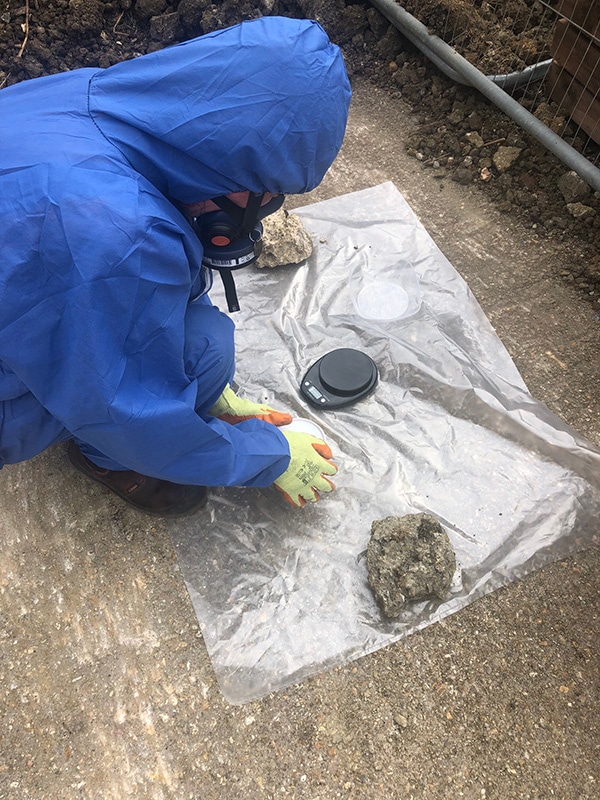 Prior to sampling, all vegetation (ground level) needs to be cleared, which should be undertaken by qualified professionals using hand tools, not power tools, to ensure safety and compliance. The area will also need to be damped down to control any fibre release.
Once the sampling strategy has been decided, i.e., gridding out the land and determining the depth of sampling using either trial pits, boreholes, or trenches, a 1kg (approx 1 litre) sample needs to be taken. Depending on the agreed survey strategy, the number of samples undertaken will be determined.
Oracle can carry out comprehensive asbestos surveys, soil sampling, and air monitoring for land development and remediation projects. If any ACMs are visible, these asbestos-containing materials are to be collected for laboratory analysis, given a unique sample reference, and sent to a UKAS-accredited lab alongside the soil samples.
While carrying out site investigations, air monitoring can be carried out depending on the site condition, weather, and exposure risk. The air monitoring and survey results will go towards formulating our recommendations for the site. We offer support and expert guidance throughout the asbestos management process to ensure compliance and safety.
All soil samples are thoroughly tested in accredited laboratories to determine the presence and concentration of asbestos.
For further information on regulatory requirements or procedures, clients can contact Oracle for guidance. Some asbestos-related tasks may be classified as non licensable work, so it is important to understand the regulatory distinctions and training requirements.
How is the asbestos in soil analysed?
Soil analysis for asbestos contamination is typically conducted through three stages: initial bulk analysis, gravimetric analysis, and fibre counting.
Stage 1: Initial Bulk Analysis – To determine if any visual fragments of Asbestos are present within the soil.
Stage 2: Gravimetric analysis to determine the mass and percentage of asbestos in soil by weight. Stage 2 will provide an overall weight % of asbestos present within the soil sample.
Stage 3: Fibre Counting and Sizing by Phase Contrast Optical Microscopy (PCOM) (Fine Fraction). This stage will provide a % of fibres present within the soil. During this stage, the aspect ratio (length-to-width ratio greater than 3:1) is used to distinguish respirable asbestos fibres under the microscope. The analysis also includes the identification and quantification of free fibres (free dispersed fibres) in the soil sample.
The results produced from these tests provide the percentage of asbestos fibres in the soil. The intended outcome of the analysis is to inform risk assessment and remediation decisions.
The above analysis will enable the client to:
- Identify the total % of asbestos present within the soil
- Identify the asbestos exposure to the contaminated land
- Help with the determination of WAC (Waste Acceptance Criteria)
What is asbestos contaminated land bulk testing?
Where there are large amounts of visible bulk asbestos material on land, soil, or waste, it is usual to take a sample of the debris. These bulk samples are tested in accredited laboratories to confirm the presence of asbestos. This initial test is a convenient and cost-effective way to confirm that the debris is indeed asbestos prior to undertaking further tests. This type of sampling is called bulk testing and analysis. The sampling method and testing/analysis are the same as general asbestos bulk testing and analysis. Once you have confirmed if the material is asbestos or not, further testing and remediation can be considered.
Proper forms must be completed to document the sampling and testing process for compliance. The analysis will produce a report confirming the presence or absence of asbestos in the tested material.
The complete asbestos contaminated land, soil and waste solution
Oracle are fully Licensed and accredited for everything you will ever need. We provide a fast, efficient and full service to ensure all of your asbestos contamination challenges are dealt with in the most cost effective and professional way available.
For a fast & free asbestos quote call
0844 800 0801 or request your quote online.
Our guarantee to YOU
- High speed & efficiency
- Highest customer service
- Highest safety standards
- Highly trained team
- Extensive insurance cover
- Fully HSE licensed
- Same cost nationwide service
- Easy to understand advice
 "There are lots of guarantees around. Here's my simple guarantee: If there's something wrong, we'll fix it."
Jess Scott - CEO
Oracle Solutions - Insurance, licences, accreditations and recognised industry bodies - Click here for full details